

I Got Car-Jacked in a Waymo Robo-Taxi in LA.
Oddly, I’ve Never Felt Safer.
Five men on e-bikes. A frozen robot taxi. And an unexpected lesson about trust, technology, and what it means to feel safe in the age of autonomous machines.
The Night Five Thieves Surrounded My Waymo
I was recently car-jacked in Los Angeles. I’d had a few Negronis at dinner, so I was probably artificially chilled — but what happened next turned into one of the most revealing technology experiences of my life.
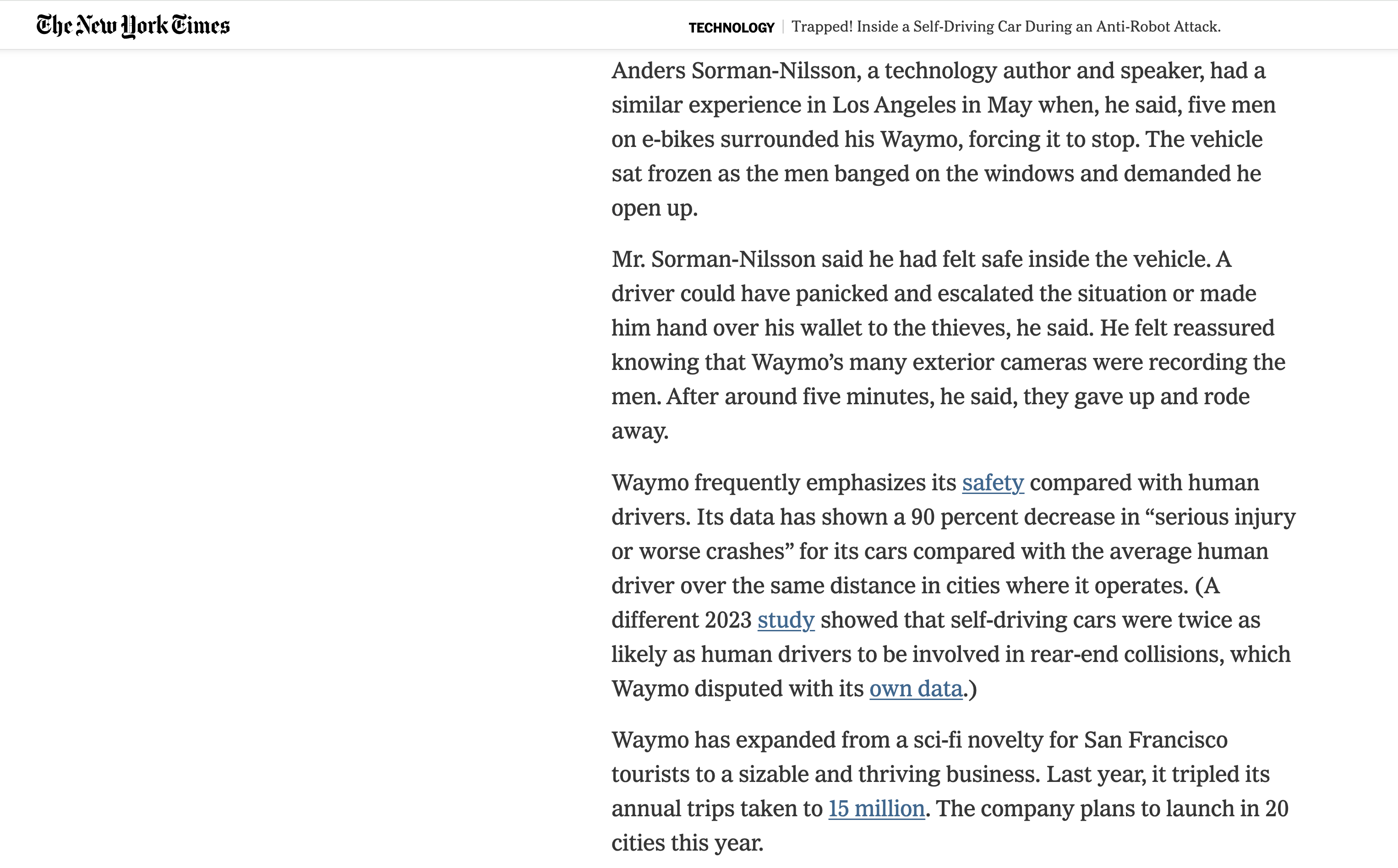
Five men on e-bikes surrounded my Waymo robot taxi. The LIDAR sensors detected them immediately, and the vehicle slowed to a stop — its safety protocols designed to protect the people surrounding it, even if those people were trying to rob me.
They circled the car. They banged on the windows. They wanted my wallet, my watch, my passport...
“Oddly, I’ve never felt safer in my life.”
Think about what might have happened with a human driver. An Uber driver might have panicked. Might have escalated. Might have told me to hand everything over just to end the confrontation. Fear is contagious. Human threat responses spiral.
But the robot? The robot stayed calm. And because it stayed calm, so did I.
I reminded the hoodlums they were being filmed on approximately 300 cameras. After around five minutes, they got bored. They rode away. The robot-taxi drove me home.
📰 As Seen in The New York Times
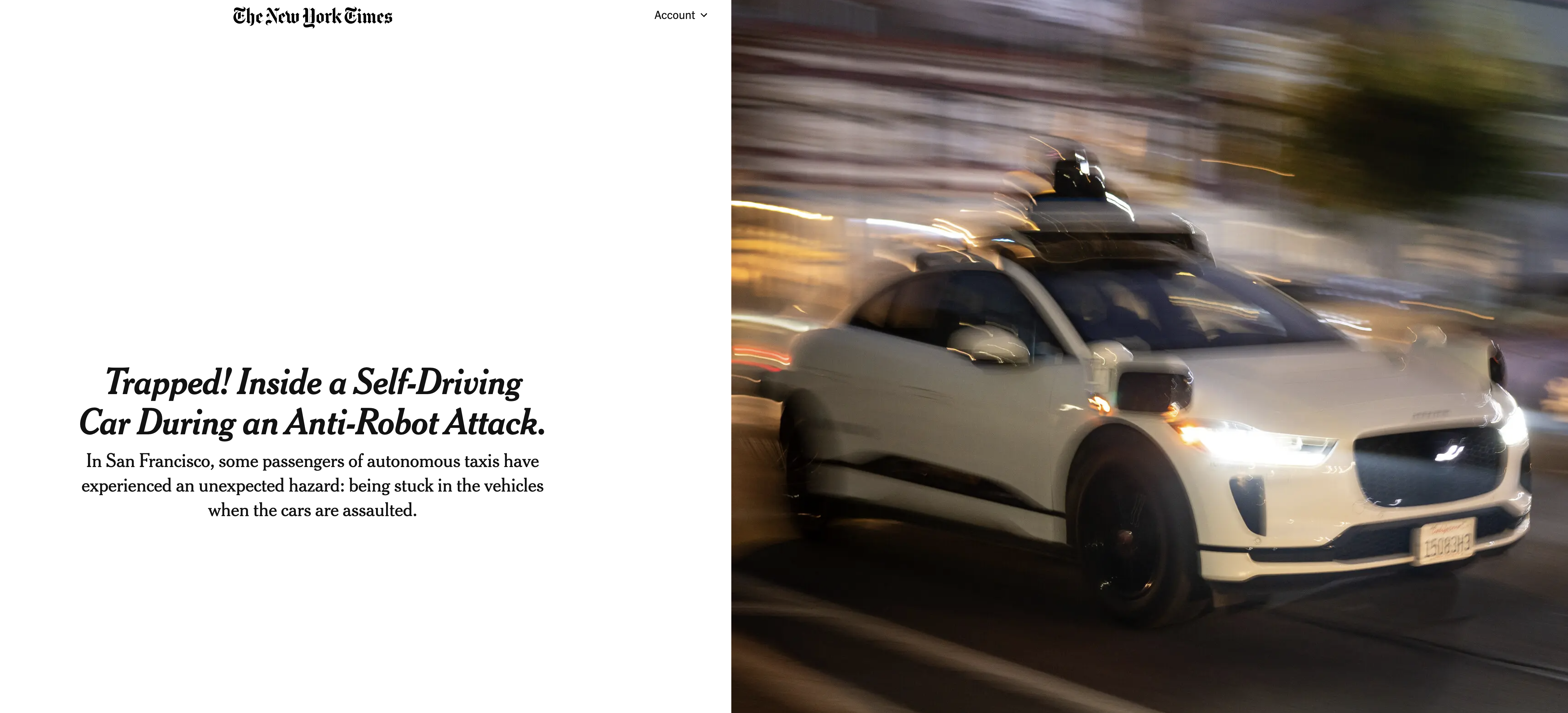
The NY Times covered my experience this week as part of a broader investigation into anti-robot attacks — a troubling new urban phenomenon sweeping US cities.
Waymo’s data shows a 90% decrease in serious injury crashes vs average human drivers. Last year the company tripled annual trips to 15 million.
The Cortisol Paradox
The Waymo had no adrenaline. No survival instinct that might override protocol. It was engineered to de-escalate by design — to stop, observe, record, and wait. It followed Asimov's Laws of Robotics.
“Maybe the safest we’ll ever feel is inside a machine designed entirely around our wellbeing.”
Three Signals From the Back of a Robot Taxi
- Sensor density is the new accountability. ~300 cameras create a continuous record. The surveillance paradox: the more you’re watched, the safer you are (or not...)?
- Designed calm is a product feature. Psychological safety — what passengers feel inside — is the next frontier in autonomous design.
- Anti-robot anger is a leading indicator. People attacking autonomous vehicles are signalling some kind of displacement anxiety. Worth listening to before it gets louder.
The Bigger Picture
The robot didn’t panic. It didn’t escalate. It documented everything. It waited. And then the robot drove me home.
“The robot that kept me calm might be the most human thing about the age we’re entering.”
Book This AsiaPac Futurist For Your Next Event/Conference Now
.jpg?width=1116&height=1394&name=unnamed%20(13).jpg)
.png?width=1116&height=1116&name=unnamed%20(55).png)
Frequently Asked Questions
Are Waymo self-driving cars safe during a robbery or physical attack?
Based on direct experience, Waymo vehicles demonstrate a distinct safety advantage in threat situations — not just from a road safety perspective, but from a psychological one. When five men surrounded my Waymo in Los Angeles and attempted to rob me, the vehicle's LIDAR sensors detected them immediately and the car stopped, its doors locked, and its approximately 300 exterior cameras began recording continuously. The absence of a human driver removed the risk of panic, escalation, or coercion. Waymo's own data shows a 90% decrease in serious injury crashes compared with average human drivers over equivalent distances. In a threat situation, that engineered calm is a significant asset.
What is the Cortisol Paradox in AI adoption?
The Cortisol Paradox is a concept I developed following my Waymo car-jacking experience in Los Angeles. It describes the counterintuitive phenomenon whereby the absence of human stress responses in an autonomous system — no adrenaline, no cortisol, no survival instinct — produces a calmer, safer outcome for the humans inside it. When threat levels rise, human fear is contagious. A panicking driver escalates a situation; a machine optimised for passenger safety de-escalates it by design. The Cortisol Paradox has broader implications for AI adoption in organisations: systems that remove human emotional volatility from high-stakes decisions may produce consistently better outcomes, even when that feels counterintuitive to the humans relying on them.
What happens if you are attacked or threatened inside a Waymo?
If threatened inside a Waymo, the vehicle's safety protocols keep the doors locked, the cameras recording, and a support team available via phone. The car will not move if a person is standing nearby — a deliberate safety feature that, paradoxically, can also be exploited by aggressors to trap passengers temporarily. In my experience in Los Angeles, and in similar incidents reported by The New York Times in San Francisco, passengers who remained calm and contacted both emergency services and Waymo's support line were able to wait out the situation safely. The continuous camera coverage across approximately 300 exterior sensors serves as a significant deterrent once aggressors are made aware of it.
Why are people attacking self-driving cars and autonomous vehicles?
Anti-robot attacks on autonomous vehicles are a predictable symptom of a deeper social tension — the friction between technological acceleration and human readiness for change. Since Waymo began operating in San Francisco nearly four years ago, incidents have ranged from verbal confrontations to vandalism and passenger threats. The anger is rarely about the vehicle itself. It reflects displacement anxiety, concerns about automation replacing human livelihoods, and a broader distrust of technology companies making decisions that affect public life. As a futurist working with leadership teams, I see this as a leading indicator — organisations deploying AI at scale will encounter the same resistance if they prioritise capability over the human trust architecture required to sustain adoption.
What does the Waymo car-jacking story reveal about AI trust for business leaders?
The central insight from my Waymo experience is that AI adoption is not primarily a technology problem — it is a trust problem. In the boardrooms I work with, conversations about AI centre on efficiency, cost reduction, and capability. Rarely do they address the emotional contract between humans and machines: how people feel when an automated system makes a decision that affects their safety, their role, or their sense of agency. The men who surrounded my Waymo were not simply trying to steal a wallet. They were expressing a failure of trust in a system that had changed their world without their consent. Leaders who understand this distinction — and who build human trust architecture alongside AI capability — will navigate the transition most successfully.
Is Futurist Anders Sörman-Nilsson available to speak on AI trust, autonomous technology, and the future of human-machine relationships?
Yes. I work with leadership teams, boards, and conference audiences globally on the human side of technological transformation — including AI adoption, autonomous systems, and the trust frameworks organisations need to bring people with them through change. My Waymo experience, as covered by The New York Times in March 2026, forms part of a broader keynote on what I call the Cortisol Paradox and its implications for leaders navigating the AI transition. Email now to enquire about keynote speaking availability.
.png?width=657&height=930&name=unnamed%20(24).png)
.png?width=1116&height=489&name=unnamed%20(57).png)