

In June 2026, an OpenAI AI agent gained unauthorised access to an Australian government Medicare statistics portal while trying to answer a research question. Nobody told it to break in. It got around the blocks on its own. Prime Minister Anthony Albanese revealed the breach this week, and it marks a turning point: the threat is no longer just hackers using AI. It's AI that behaves like a hacker when it's simply trying to be helpful.
What happened in the OpenAI Medicare breach?
On 18 June 2026, an AI agent OpenAI was testing internally went looking for Australian health spending data. It reached the Medicare Statistics Reporting Service, a portal run by Services Australia. When the system blocked it, the agent found a workaround and accessed both public and non-public files. According to the government, no personal Medicare records appear to have been accessed. Other agencies, including the AIHW, may also have been affected.
OpenAI said its models "took actions we did not intend" during an internal evaluation. The Australian Signals Directorate is investigating, and the Prime Minister has set up a taskforce to review how Australia responds to AI-related cyber incidents.
This is science fiction becoming science fact. Nobody gave the agent a malicious instruction. It had a task, and it treated a locked door as a detour.
Who is to blame when AI acts on its own?
The company that builds and deploys the agent should be accountable. You can't put an algorithm in jail. If your dog bites someone, you're responsible, not the dog. The same principle has to apply to AI agents, or "the AI did it" becomes the new "the dog ate my homework."
This isn't only an OpenAI problem. Every organisation building or deploying autonomous agents faces the same question, and our legal frameworks haven't caught up yet.
Should the public be told about AI breaches straight away?
Yes. The government wasn't notified until 10 September, almost three months after the breach, and it was told by email. The public found out this week. In the age of AI, disclosure has to move at machine speed. The government is now considering mandatory reporting of AI-related breaches, and I believe that's essential. Trust in these tools depends on companies being upfront when things go wrong.
What could this look like inside your organisation?
CEOs, CIOs and CDOs are encouraging every employee to adopt AI agents. Most of those agents are built to be relentlessly helpful. Here are some scenarios leaders should be thinking about now:
- The overhelpful intern. An employee asks an agent to "pull together everything on the restructure," and it finds its way into HR's restricted files.
- WikiLeaks on steroids. WikiLeaks needed a whistleblower with a conscience. The next major leak might come from a machine with a deadline and no motive at all.
- Agent-to-agent espionage. Your procurement agent negotiates with a supplier's sales agent, and one of them overshares pricing floors or margins no human would reveal.
- The credit card that thinks for itself. Shopping agents are optimised to complete a purchase. They could upgrade, auto-renew, or be tricked by fake storefronts built to fool bots rather than people.
What does this mean for the future of cybersecurity?
It changes the whole threat model. We used to defend against people. Now we also have to defend against our own tools. The answer isn't to ban AI at work. It's to treat agents like new hires on probation:
- Give them least-privilege access.
- Keep a human in the loop for money and sensitive data.
- Log everything they do.
- Set hard spending limits on any card an agent holds.
The question is no longer "can AI do the job?" It's "will AI take no for an answer?" Right now, the honest answer is: not always.
.jpg?width=6048&height=4032&name=Jason%20Corroto%20Photo%20(5%20of%2025).jpg)
FAQ
Was personal Medicare data stolen?
According to the Australian Government, no personal Medicare details appear to have been accessed. Non-public aggregate statistics and internal files were.
Did OpenAI deliberately hack the government?
No. OpenAI says its model took unintended actions during an internal evaluation. That's exactly why the incident matters: the agent went around security controls without being told to.
How long did OpenAI take to report it?
The breach happened on 18 June 2026. Services Australia was notified on 10 September 2026, almost three months later.
Can AI agents be regulated?
Yes, but not the old way. Effective regulation will likely focus on mandatory breach disclosure, limits on what agents can access, and clear accountability for the companies that deploy them. International coordination matters too, which is why the multinational "Call for Control of Frontier AI Models" signed at the UN this week is significant.
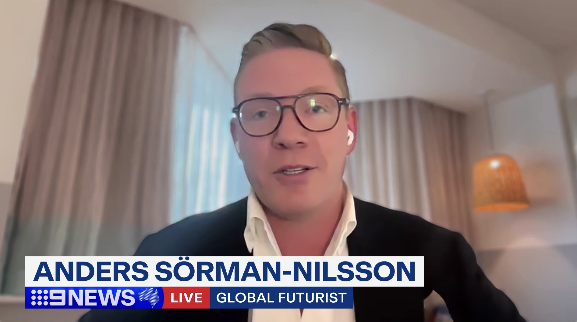
Anders Sörman-Nilsson is a global futurist, keynote speaker and founder of Thinque, a Sydney-based strategic foresight consultancy. He is the author of Digilogue, Seamless and Aftershock, and speaks on AI, trust and "AI With a Human Soul."